
How to Order Food in Thai: Street Stall and Restaurant Phrases, From Not Spicy to the Bill
A Thai food order is a sandwich. Dish, then the changes, then khâ or khráp. Spice, allergies, jay, the bag, and the bill.
English orders lunch like a letter. Hi, could I please get the basil stir-fry, not too spicy, no MSG, and can I eat it here? Thai orders lunch like a sandwich. The dish. The changes. A polite particle. Then you eat.
Dish + changes + ค่ะ or ครับ.
That is the whole sport. Ao phàt gà-phrao gài mâi phèt khâ. I will take basil stir-fry, chicken, not spicy, polite particle. The stall already knows you are hungry. You just have to name the plate.
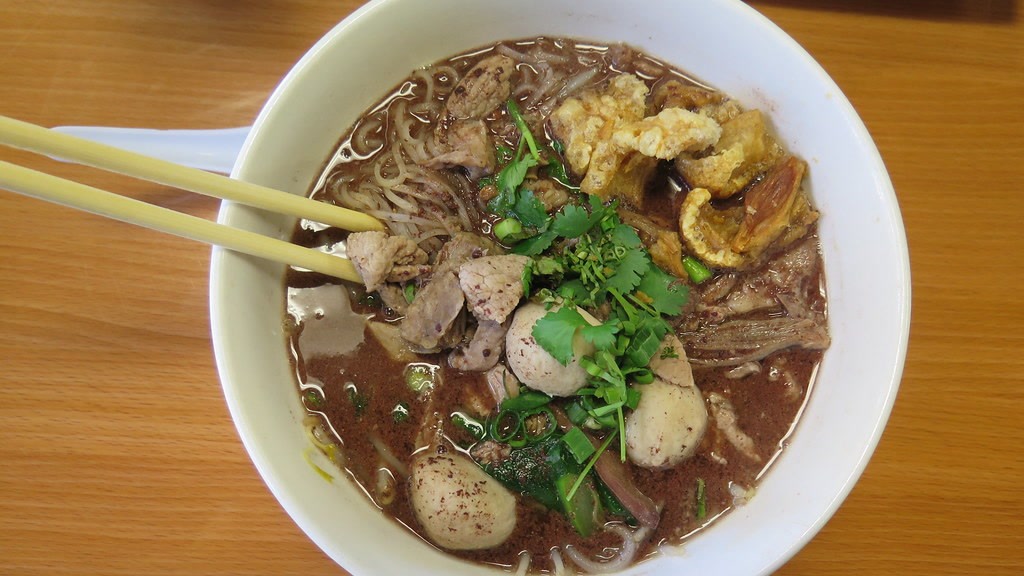
Noodles have their own sandwich, noodle plus broth plus meat. That page is How to Order Noodles in Thai. This page is every other meal, from the plastic stool to the bill.
Day-one starter kit
- I’ll take: เอา… ao…
- Leave it out: ไม่ใส่… mâi sài…
- The bill: เช็คบิล chék bin
Stick ค่ะ khâ or ครับ khráp on the end. The particle follows you, the speaker. That ladder lives in Thai ending particles.
The whole sandwich, out loud
เอาผัดกะเพราไก่ไม่เผ็ดค่ะ
ao phàt gà-phrao gài mâi phèt khâ
Basil stir-fry, chicken, not spicy, please. (This is the recipe. Steal it.)
How to order food in Thai
A Thai stall is not waiting for your life story. It is waiting for a stack of nouns.
Ao is “I’ll take.” Khǒr is “may I have.” Both work. Ao is what regulars use when they are not performing manners for a textbook. You can still be polite. That is what khâ and khráp are for.
Point if the Thai leaves you. Pointing plus ao plus mâi phèt plus khâ is a legal lunch. The stall has seen worse. The stall has seen people order in English and then look betrayed when the wok was hotter than the menu photo.
Read it left to right like a receipt. That is how the cook hears it.
Street stall or a table
Two rooms. Same sandwich. Different manners around it.
รถเข็น
rót khěn
Catch their eye. Call them phêe if they are older in your generation, bpâa or lung if they are a generation up. Order before you sit, or someone else sits. Pay when the plate lands, usually cash, usually the person who just cooked it. Eat here unless you say otherwise.
ร้านอาหาร
ráan aa-hǎan
Sit. Ask for the menu. The sandwich still works, with a little more ná khá or ná khráp if you want it soft. Drinks come first. The bill comes when you ask. QR and cards show up here more often than they do on the sidewalk.
Family words as you are the kinship guide. If you cannot see the age, stay on khun. Guessing is how tourists write comedy.
Get the stall’s attention
พี่คะ
phêe khá
Excuse me. (A woman, to someone a bit older. Swap in khráp if that is your particle. Swap in bpâa or lung if the generation is obvious.)
At a table, ask for the menu
ขอเมนูหน่อยครับ
khǒr meh-nuu nòi khráp
May I have the menu? (หน่อย nòi softens it. Tiny word. Big manners.)
They will often help you. Learn the question, then learn your answer.
They ask what you want
เอาอะไรดีคะ
ao à-rai dii khá
What’ll you have? (Your cue. Start with ao.)
You ask what is good
แนะนำอะไรคะ
náe-nam à-rai khá
What do you recommend? (Then point at the thing they name, so you both mean the same plate.)
The order sandwich, for any dish
Slot 1 is ao or khǒr. Slot 2 is the dish. Slot 3 is whatever you need changed. Slot 4 is the particle.
You do not need the whole menu. You need a few plates you can say under pressure, and the courage to point at the rest.
ผัดกะเพรา
phàt gà-phrao
basil stir-fry
Holy basil, chili, a protein. The weekday hero. Menus also write กระเพรา.
ข้าวผัด
khâao phàt
fried rice
Say the animal after it. กุ้ง shrimp, ไก่ chicken, หมู pork.
ผัดไทย
phàt thai
pad thai
You already know the taste. Now you can order the heat.
ต้มยำ
dtôm yam
tom yum
Hot and sour. Famous. Not a mild soup wearing a costume.
ส้มตำ
sôm dtam
green papaya salad
Sour, salty, spicy. Ask for the spice on purpose.
ไข่ดาว
khài daao
fried egg
The add-on. Basil without the egg is legal. Basil with the egg is correct.
Protein words you already need: ไก่ gài chicken, หมู mǒo pork, กุ้ง gûng shrimp, เนื้อ núea beef. Same animals as the noodle stall.
Basil, chicken, fried egg
เอาผัดกะเพราไก่ไข่ดาวค่ะ
ao phàt gà-phrao gài khài daao khâ
Basil stir-fry, chicken, fried egg. (Dish, animal, extra. Then stop talking.)
Fried rice, shrimp, to go in a bag
เอาข้าวผัดกุ้งใส่ถุงครับ
ao khâao phàt gûng sài thǔng khráp
Shrimp fried rice, in a bag. (The change can be the packaging.)
Phí-sèet means special: more meat, more money, more joy. It works on rice and basil the way it works on noodles. Tham-má-daa means the normal plate. Fine.
The spice ladder
Thai spicy and your spicy are not the same animal. Their “a little” can still introduce you to the ceiling. Order the rung you mean.
They will check. Gin phèt dâai mǎi. Can you eat spicy? Answer the rung, do not answer with a brave nod you will regret.
They ask
กินเผ็ดได้ไหมคะ
gin phèt dâai mǎi khá
Can you eat spicy? (A question. Women often close questions with khá, the high one.)
You, if you need it gentle
ไม่ได้ค่ะ ขอไม่เผ็ด
mâi dâai khâ, khǒr mâi phèt
I can’t. Not spicy, please. (Polite. Clear. No speech.)
You, if you want a small dare
ได้ครับ เผ็ดนิดหน่อย
dâai khráp, phèt nít nòi
Yes. A little bit spicy. (You can still add mâi sài phrík if “a little” has betrayed you before.)
If the plate arrives hotter than the order, you can say phèt bpai “too spicy” and ask for the next one mâi phèt. You will not win a refund argument with a poem. You might get a kinder bowl.
Leave it out
Mâi sài means “don’t put in.” It is the useful half of a personality. Say the thing you want left out. Then stop.
No MSG, said like a regular
ไม่ใส่ผงชูรสนะคะ
mâi sài phǒng chuu rót ná khá
No MSG, please. (นะคะ is the softener. High คะ, not falling ค่ะ. More in Thai ending particles.)
No fish sauce, no shrimp paste
ไม่ใส่น้ำปลา ไม่ใส่กะปิครับ
mâi sài náam bplaa, mâi sài gà-bpì khráp
No fish sauce, no shrimp paste. (Say both. They are different jars.)
Mâi sài is a request about what goes in next. It is not a lab test of the sauce already in the bottle. If you have an allergy, use the next section, and use the card.
Allergies, and a card you can show
Pháe means allergic. Put your I in front of it. ฉัน chán and ผม phǒm are the usual pair, and the full wardrobe is in Thai pronouns.
Say it. Then show it. A hot wok is a loud place, and a screenshot does not get shy.
Allergy card. Screenshot this and show the cook.
ฉันแพ้ถั่วลิสง
chán pháe tùa lí-sǒng
I have a peanut allergy.
ฉันแพ้อาหารทะเล
chán pháe aa-hǎan thá-lee
I have a seafood allergy. Shrimp, shellfish, the sea.
ฉันแพ้กลูเตน
chán pháe gluu-dten
I have a gluten allergy.
ไม่ใส่ผงชูรส
mâi sài phǒng chuu rót
No MSG.
ไม่ใส่ถั่ว
mâi sài tùa
No nuts or beans. Wider than peanuts. Soy and mung beans live here too.
Cross-contact is possible. This is not a guarantee. One wok cooks every order. Saying it, and showing it, tells the cook what you need. It does not make a shared kitchen safe. If your I is ผม phǒm, change ฉัน to ผม before you show the card.
Tùa lí-sǒng is the peanut. Tùa alone covers peanuts, soy, mung beans, and the nuts a cook files under “bean.” If you only mean peanuts, say the long one. If a trace of any of them is a problem, say mâi sài tùa and still assume the spoon has traveled.
gluu-dten is a loanword. Hotels and cafes often know กลูเตน. A sidewalk wok may not. Add ไม่กินแป้งสาลี mâi gin bpâaeng sǎa-lii, “I don’t eat wheat flour,” when you need the ingredient instead of the English idea.
Be specific when the umbrella word is too big. Aa-hǎan thá-lee is seafood. กุ้ง gûng is shrimp, หอย hǒi is shellfish, ปู bpuu is crab. นม nom is milk. ไข่ khài is egg.
Peanut, said by a guy
ผมแพ้ถั่วลิสงครับ
phǒm pháe tùa lí-sǒng khráp
I have a peanut allergy. (Same card, his I, his particle.)
Say the serious one out loud too
แพ้กุ้ง แพ้หอย แพ้ปู
pháe gûng, pháe hǒi, pháe bpuu
Allergic to shrimp, shellfish, crab. (Use the ones that are yours. Skip the rest.)
Vegetarian, vegan, and เจ
Three words. They are not the same plate.
มังสวิรัติ
mang-sà-wí-rát
No meat, no fish. Eggs and dairy still wander onto plates. Fish sauce still wanders into the wok. Say what you actually skip.
เจ
jay
No meat, no fish, no egg, no dairy. During the jay festival, garlic, onion, and chives often go too. Outside the festival, a “jay” menu is usually the no-animal version, and garlic may still be in the pan. Ask.
วีแกน
wii-gaen
Bangkok cafes know the loanword. A plastic-stool stall may not. There, say jay, then ban fish sauce, shrimp paste, and dried shrimp by name.
The hidden trio, if you do not eat animals at all: น้ำปลา náam bplaa fish sauce, กะปิ gà-bpì shrimp paste, กุ้งแห้ง gûng hâeng dried shrimp. Som tam is not vegetarian just because you can see papaya.
The stall sentence
ฉันกินเจ ไม่ใส่น้ำปลา ไม่ใส่กะปิค่ะ
chán gin jay, mâi sài náam bplaa, mâi sài gà-bpì khâ
I eat jay. No fish sauce, no shrimp paste. (Clearer than the English word vegan, at a cart.)
No meat, no fish, and say the egg
ไม่กินเนื้อ ไม่กินปลา ไม่ใส่ไข่ครับ
mâi gin núea, mâi gin bplaa, mâi sài khài khráp
I don’t eat meat, I don’t eat fish, no egg. (Use this when มังสวิรัติ feels like a spelling bee.)
Eat here or take it home
Stalls assume you are eating on the stool until you say otherwise. Restaurants assume you are eating at the table. Tell them when you are about to leave with the food.
They may ask first. Good. Answer with one line.
They ask
กินที่นี่หรือกลับบ้านคะ
gin thîi nîi rǔe glàp bâan khá
Eat here, or take it home?
Here
กินที่นี่ค่ะ
gin thîi nîi khâ
I’ll eat here.
Bag
ใส่ถุงครับ
sài thǔng khráp
In a bag, please.
Water, ice, and a less-sweet drink
Thai drinks are sweet the way Thai chili is spicy: the house version is a commitment. Order the sweetness on purpose. Ice is the default in anything cold. Say so if you do not want it.
น้ำเปล่า
náam bplào
plain water
The free glass, or a bottle if you point at the fridge.
น้ำแข็ง
náam khǎeng
ice
ไม่ใส่น้ำแข็ง if you want it gone.
น้ำดื่ม
náam dùem
drinking water
The bottle kind. Ask for a ขวด if you want to see a cap.
ชาเย็น
chaa yen
Thai iced tea
Orange, milky, sweet unless you edit it.
หวานน้อย
wǎan nói
less sweet
The rung that saves tourists. Still a little sweet.
ไม่หวาน
mâi wǎan
not sweet
No sugar. หวานปกติ is the normal one, which is a lot.
Water, no ice
ขอขวดน้ำเปล่า ไม่ใส่น้ำแข็งค่ะ
khǒr khùat náam bplào, mâi sài náam khǎeng khâ
A bottle of plain water, no ice. (ขวด khùat is the bottle.)
Iced tea, less sweet
ชาเย็นหวานน้อยครับ
chaa yen wǎan nói khráp
Thai iced tea, less sweet. (หวานปกติ wǎan bpòk-gà-dtì is the full sweet. Order it only on purpose.)
Hot is ร้อน rórn. Chaa rórn is hot tea. Náam rórn is hot water. Useful when your stomach has opinions.
The bill, the split, the QR
At a stall you often pay the cook when the food arrives. Catch their eye and ask the price, or hand over a note. At a restaurant, nothing happens until you ask. Waving a credit card at the ceiling is a hobby, not a phrase.
You may hear staff say เก็บเงิน gèp ngern when they come around to collect. That one is theirs. Your line is chék bin or khít ngern.
At the restaurant
เช็คบิลค่ะ
chék bin khâ
Check, please. (Two words. Then wait. Then pay.)
At the stall
คิดเงินหน่อยครับ
khít ngern nòi khráp
Can you add it up? (หน่อย keeps it soft.)
Split it
ขอแยกบิลได้ไหมคะ
khǒr yáek bin dâai mǎi khá
Can we have separate bills?
The scan
จ่ายคิวอาร์ได้ไหมครับ
jàai khiu aa dâai mǎi khráp
Can I pay by QR?
If it was good, say so. อร่อยมาก à-ròi mâak is “delicious.” อร่อยมากค่ะ, aimed at the person who cooked, is a complete thank-you. Khòp khun khâ or khòp khun khráp still works. ขอบคุณครับผม is a lot of bow for a plate of rice. The particles page explains why.
One lunch, out loud
Same grammar. A whole meal. Steal the lines that match the room and your particle.
- Attention. Phêe khá. Or bpâa khráp, if that is the generation and your particle.
- The plate. Ao phàt gà-phrao gài khài daao mâi phèt khâ.
- The leave-out, if you need it. Mâi sài phǒng chuu rót ná khá.
- Here or away. Gin thîi nîi khráp. Or sài thǔng khâ.
- The drink. Khǒr náam bplào mâi sài náam khǎeng khâ.
- The end. Chék bin khráp. Or, at the cart, thâo-rài khá.
If your brain dumps the Thai at the last second, point, say ao, say mâi phèt or mâi sài phrík, add khâ or khráp. That is a legal plate. You are already ahead of the person ordering a surprise.
Food order cheat sheet
You do not need every plate on day one. You need ao, one dish, one change, and khâ or khráp. The rest is seasoning you add when the rice already tastes like something.
Say the sandwich out loud like you mean it. Then go eat. The stool might not wait. Move.