
Thai Pronouns: How to Say I, You, He, She, We, and They
Thai pronouns for I, you, he, she, we, and they, with audio, plus why some people just use their name.
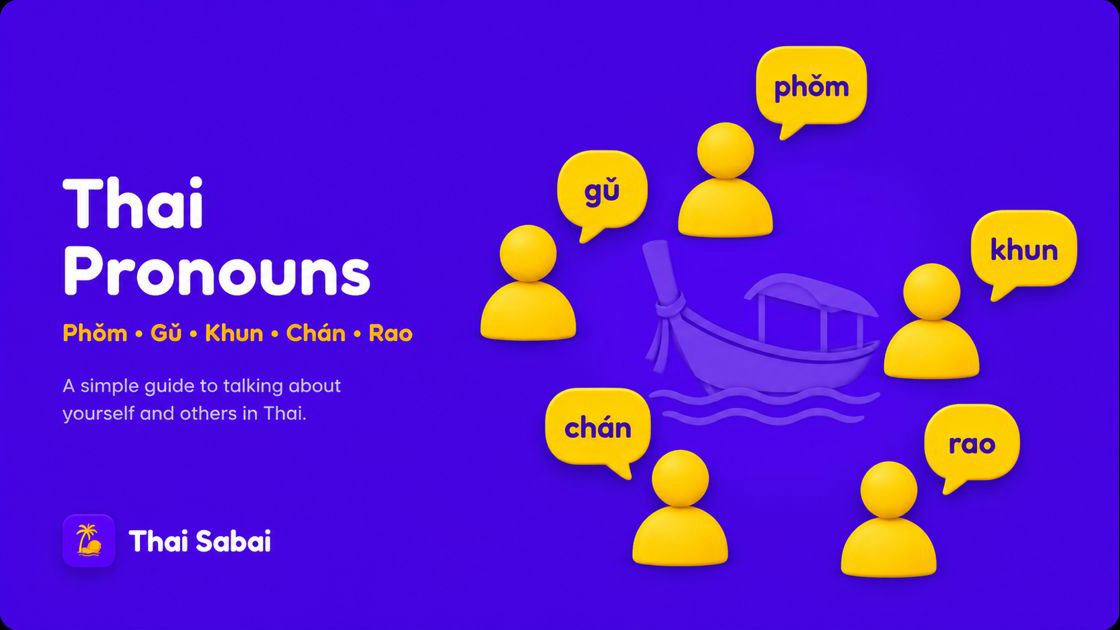
Thai pronouns do not work like English ones. English gave you one I and called it a day. Thai looked at that, laughed politely, and built a whole wardrobe. Same person. Same Tuesday. Four different ways to say “me,” depending on whether you are being a gentleman, a normal human, extra polite, or a raccoon who just found the night-market Wi-Fi password.
This is a practical map of I, you, he, she, we, and they in Thai. Scan it. Tap the audio. Steal the examples.
Thai pronouns are a vibe check
Thai pronouns are social, not just grammatical. You pick them the way you pick a shirt: who are you, who are they, how close are you, and how much trouble do you want.
If you remember nothing else:
- Start polite.
- Match the room.
- Thai is flexible. Locals will still understand you if you pick a slightly weird option. They will just file you under “cute foreigner who tried.”
And the secret bonus rule: Thai often drops the pronoun if it is already obvious. Someone can just say “hungry already” and the room knows who. You. The mango. The universe. Context does a lot of unpaid intern work in this language.
Day-one starter kit
- I: ผม / ฉัน phǒm / chán
- you: คุณ khun
- he / she: เขา khǎo
Everything else is seasoning. You can live on these three for months.
I in Thai: phǒm, chán, dichán, and gǔ
Four stars. Four vibes. One job: point at yourself.
ผม
phǒm
The classic guy I. Works at work, with strangers, with your girlfriend’s parents. If you are unsure and you want the default male lane: this one. It is the polo shirt of pronouns. Not a membership card.
ฉัน
chán
The everyday I you hear from women all day. Soft, normal, not trying too hard. Songs love it. So do plenty of guys. Default is not destiny.
ดิฉัน
dichán
Chán put on nice shoes. Interviews, hotel desks, talking to someone’s grandma. If you would not wear flip-flops there, consider dichán.
กู
gǔ
Among tight friends it can sound warm and chaotic. With anyone else it can sound like you just insulted their ancestors. Do not debut this at the visa office.
Four ways to say I, out loud
Same hunger. Four personalities. Hit listen and steal the melody. Thai is much easier once your ears have a copy.
ผมหิวแล้ว
phǒm hǐu láew
I’m hungry already. (male, polite-normal)
ฉันหิวแล้ว
chán hǐu láew
Same sentence. Same stomach. Different I.
ดิฉันขอโทษค่ะ
dichán kǒr thôht khâ
I’m sorry. (formal feminine, the “I bumped the display at the mall” voice)
กูไม่รู้ว่ะ
gǔ mâi rúu wá
I dunno, man. (friends only. If you would not share fries with them, do not use gǔ.)
Quick cheat: the usual defaults are phǒm for guys, chán for women, dichán for fancy rooms, gǔ for friends-only chaos. Usual. Not required.
You do not have to match the gender on the tin. Thai will let you pick the one that sounds like you. Femme boy, twink, a little bit sparkly: chán can sit right. A bit of a butch woman: phǒm can sit right. Or you are with a bunch of boys and you grab phǒm as a joke so you blend in for five minutes. People get it. It is a vibe, not a passport stamp.
Using your name instead of I
Some people skip the pronoun and just use their name. Especially women. Mew hungry already. Ploy don’t know. No chán. No dichán. Just the name, standing there like a signature.
It can sound warm and close, like you have been friends since before anyone owned a real sofa. It can also sound like she thinks she is a walking sticker pack. That “wow, she thinks she is so cutesy” energy. Not everyone can pull it off. If it sounds cute in your head and a bit much out loud, trust the second one.
Guys do it too. Less often, same gamble. If you would not say it in a group chat with people who have seen you eat, maybe stick with phǒm.
มิวหิวแล้ว
Mew hǐu láew
Mew is hungry already. (name as I. Cute if it is her real register. Costume if it is not.)
Other Thai pronouns: nǔu the mouse, and the formal ones
The main map is enough to order noodles. The language still has a few extra hangers in the closet. One of them you will actually hear. The rest live on plaques.
หนู
nǔu
Yes, the animal. Used as I when you are younger, or talking to someone older, and you want to make yourself small on purpose. Kids. Plenty of women with teachers, bosses, parents. Soft, humble, a bit cute. Also used as you toward a little kid. A grown tourist debuting this at a bar will sound like they brought a costume.
หนูหิวแล้ว
nǔu hǐu láew
I’m hungry already. (mouse I. Fine from a younger speaker to an older one. Weird from a 40-year-old at the night market.)
Then the museum shelf. You will meet these in textbooks, news, and very shiny rooms. You do not need them to buy fruit.
dichán already covers “I put on nice shoes.” khun already covers polite you. These three are what happens when someone opens the protocol binder. Recognize them. Nod. Go back to phǒm and chán.
You in Thai: khun and ther
English you is a blunt instrument. Thai you is a dimmer switch. You can be respectful, soft, close, or “we have seen each other eat mango sticky rice with our hands.” The two you actually need first are khun and ther.
คุณ
khun
The Swiss Army you. Shop staff, teachers, your Grab driver, that person whose name you forgot three seconds ago. You can live a long, happy life on khun alone.
เธอ
ther
Softer. Friendlier. Sometimes a little romantic. Also used as she when you are talking about someone, not to them. Same word. Different camera angle. Thai loves that.
คุณชื่ออะไรครับ
khun chûe à-rai khráp
What’s your name? (safe with almost anyone)
เธอไปไหน
ther bpai nǎi
Where are you going? (a friend, not the immigration officer)
If your brain is full, park it here: khun = polite you. ther = close you (and sometimes she).
Thai also lets you use family words as you. Older sibling, auntie, uncle, the whole social shelf. You are not saying they are actually your relatives. You are parking someone by age. That is a whole sport, so it gets its own guide.
When you are guessing, khun will not start a family incident.
He and she in Thai: khǎo does both
English panics without he and she. Thai shrugs, orders another iced coffee, and keeps talking.
The big one is เขา (khǎo). It can mean he, she, or even they, depending on the sentence. Thai does not always need to announce gender like a sports commentator. The rest of the sentence, or the fact that you already know who you are gossiping about, does the job.
Then there is เธอ (ther) again. Talking to someone, it is you. Talking about someone, it can be she. If that feels like a plot twist, welcome to Thai. The language would rather be natural than fill in a spreadsheet.
เขา
khǎo
The default third person. Point at a person who is not in this conversation. Gender optional. Stress optional. Very “you had to be there.”
เธอ
ther
When it is she, you are usually talking about a woman you can picture. When it is you, you are in the chat. Listen to the rest of the sentence. It will snitch.
เขาเป็นหมอ
khǎo bpen mǒr
He / she is a doctor. (Thai did not tell you which. You already knew, or you will ask.)
This is the bit that makes English speakers itch. Let it itch. Then let it go. Nobody in the noodle shop is waiting for you to declare a pronoun paradigm. They just want to know if khǎo is coming to dinner.
We and they in Thai: rao the shapeshifter
Here is where Thai gets playful. Bring a snack.
เรา (rao) is famous for meaning we. It also, casually, means I. Same word. Different size of group. Sometimes the group is just you, standing there, narrating your own life like a documentary. “Anyway, rao went to 7-Eleven…” is a perfectly normal I.
When you want to be extra clear that it is a team, you can say พวกเรา (phûak rao). Phûak is like sticking a little “the bunch of” in front. Bunch-of-us. We. Useful when rao alone might sound like you are talking about yourself in the royal we, which you are not, unless you are, in which case we need a different article.
For they, the clear version is พวกเขา (phûak khǎo). Bunch-of-them. They.
And then Thai, being Thai, also lets you just say khǎo for they, if the “them” is already obvious. Flexible. Slightly chaotic. Extremely usable. This is not Thai forgetting the rules. This is Thai trusting you to keep up.
เราไปกันไหม
rao bpai gan mǎi
Shall we go? (classic we, you plus at least one other doomed tourist)
พวกเราพร้อมแล้ว
phûak rao phróm láew
We’re ready. (the bunch of us, not a lone wolf)
พวกเขาอยู่ที่นั่น
phûak khǎo yùu thîi nân
They’re over there. (bunch-of-them energy)
So, on one sticky note: rao can be I or we. phûak rao is we-for-sure. phûak khǎo is they-for-sure. khǎo can still be he, she, or they if the room already knows. If that feels like too many jobs for a few short words, congratulations. You have understood Thai pronouns.
Thai pronoun cheat sheet
If this were a fridge magnet:
- I: phǒm (usual guy default), chán (usual everyday), dichán (formal feminine), gǔ (friends-only chaos). nǔu is the mouse I for younger speakers talking up. Gender is a starting point, not a lock. Femme guys use chán. Butch women use phǒm. Sometimes it is a joke with the boys. Some people use their name instead. Cute when it is real. Cutesy when it is a performance. gràphǒm and khâa phá jáao exist for speeches and forms. You can leave them in the museum.
- You: khun (polite), ther (close, and sometimes she). thâan is the extra-polite you at hotels. Family words as you get their own guide.
- He / she: khǎo does both. Ther can be she.
- We: rao, or phûak rao if you want the whole gang.
- They: phûak khǎo, or just khǎo when it is obvious.
You do not need all of these on day one. You need one I, one you, and khǎo. The rest is seasoning you add when the soup already tastes like something.
Thai pronouns look like a maze from the outside. From the inside they are more like a night market: lots of stalls, same street, you walk through and pick what fits. Nobody is timing you with a stopwatch. If you say phǒm when rao would have been cooler, you still get the noodles.
Practice the audio a couple of times. Say the sentences out loud like you mean them: hungry, sorry, “shall we go,” the whole sitcom. Then go eat. The pronouns will still be there after mango sticky rice. They always are.